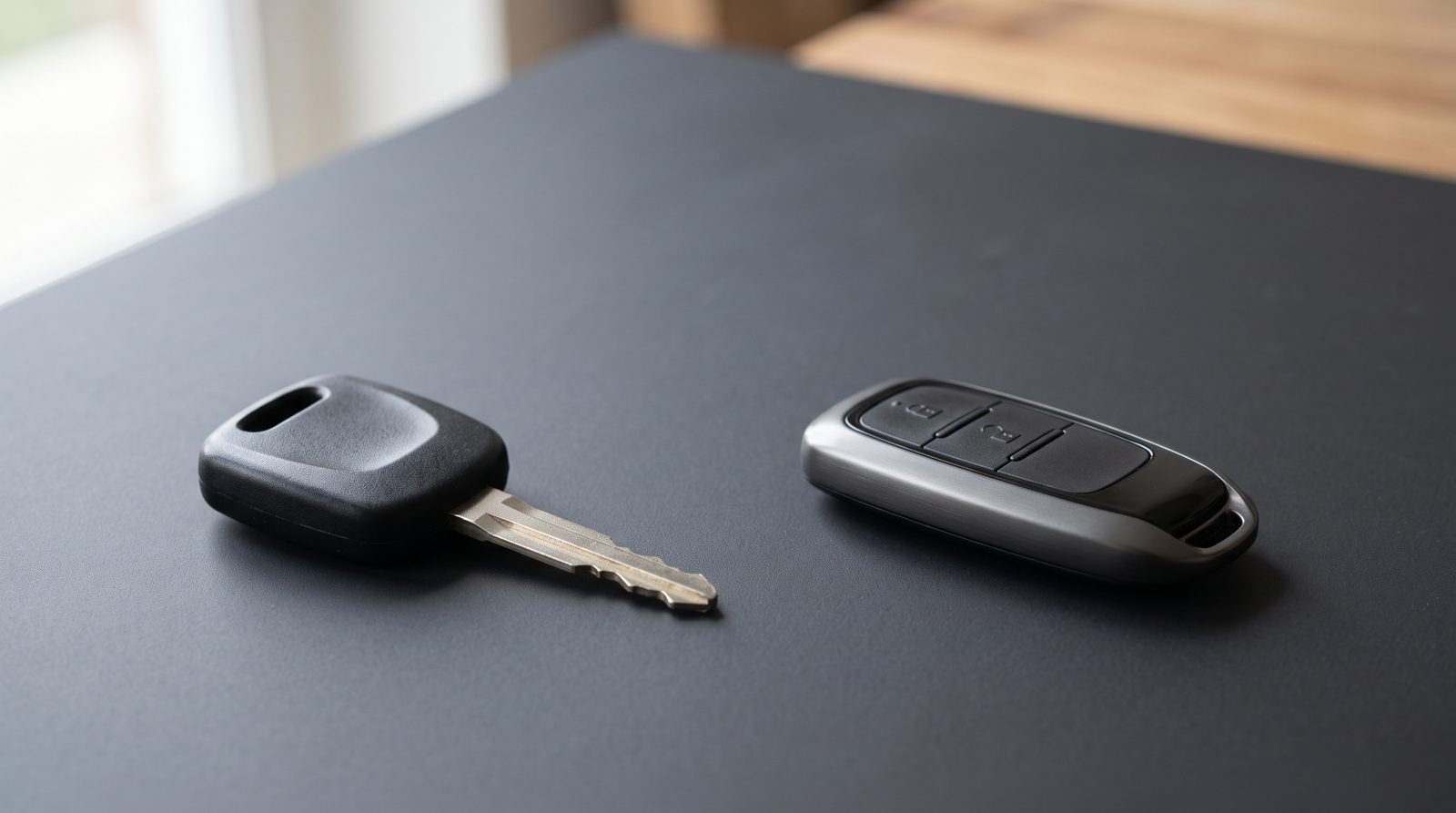
What a Transponder Key Actually Is
A transponder key is a traditional metal key with a tiny microchip embedded in the plastic head. "Transponder" is short for transmitter-responder, which describes exactly what the chip does: when you insert the key and turn it, an antenna ring around the ignition cylinder sends out a low-power radio signal, the chip answers with a unique code, and the car's immobilizer checks that code against what it has stored. Match the code, the engine starts. No match, the engine cranks but won't run.
This technology became standard on most vehicles through the late 1990s and 2000s, and it's still common today. The key thing to understand is that the metal blade and the chip are two separate jobs. A hardware store can cut a blade that fits your door and ignition, but a key that hasn't been programmed to your specific car will turn the cylinder and still refuse to start the engine. Both the cut and the programming have to be done for the key to work.
- Has a physical metal blade you insert and turn
- Contains a chip that must be electronically programmed to your car
- A copied blade alone will not start the engine without programming
- Works at very short range, only when inserted in the ignition
What Makes a Smart Key Different
A smart key, sometimes called a proximity key, key fob, or push-to-start key, takes the same anti-theft idea and removes the need to physically insert anything. Instead of a chip that wakes up only inside the ignition, a smart key constantly broadcasts a rolling encrypted signal. When the fob is inside or near the vehicle, the car detects it, unlocks the doors as you grab the handle, and lets you start the engine by pressing a button while your foot is on the brake.
Because the key never goes into a slot, the security handshake happens over a wider range using more advanced encryption that changes with each use. Most smart keys also hide a small mechanical blade inside the fob, a backup you can pull out to unlock a door by hand if the fob battery dies. That dead-battery situation is the most common smart-key surprise: the car may still start if you hold the fob against a specific spot on the steering column or center console, a trick worth looking up in your owner's manual before you ever need it.
- No insertion needed; the car senses the fob nearby
- Uses rolling, encrypted codes that change each time
- Usually hides a mechanical backup blade for manual entry
- Relies on a small fob battery that eventually needs replacing
How to Tell Which One You Have
The fastest test is how you start the car. If you slide a key into a slot and twist, you have a transponder key (or an older non-chip key on very old vehicles). If you press a START/STOP button while keeping the fob in your pocket or cupholder, you have a smart key system.
There are in-between cases. Some vehicles use a key you insert and then turn while the fob stays attached, and some have a fob you slot into a dash receptacle and twist. Look at the head of the key, too: a thick plastic fob with lock, unlock, and panic buttons usually signals a smart or remote-head key, while a slimmer key with a separate plain metal spare often points to an older transponder setup. When in doubt, the year, make, and model of your car will tell a locksmith exactly which system is in play.
What This Means When a Key Is Lost or Fails
The type of key directly affects how a replacement gets made. For a transponder key, a locksmith cuts a blade to match your vehicle and then programs a new chip to your car's immobilizer. For a smart key, there's no blade to cut for starting the car; instead the fob itself is paired to the vehicle electronically, and the hidden emergency blade is cut separately for manual door access.
Either way, programming is the step that turns a blank into a key that actually drives your car, and it requires the right equipment plus access to the vehicle. If you've lost every key, the process often involves resetting what the car recognizes so an old lost key can no longer be used. This is also why it helps to have a spare made before you're down to one: replacing a single remaining key is usually more straightforward than starting from zero. Whichever situation you're in, having your vehicle's year, make, and model handy speeds things up, along with proof of ownership, which we confirm before starting key work.
- Transponder: blade is cut, then a chip is programmed to the car
- Smart key: the fob is paired electronically; the backup blade is cut for doors
- All-keys-lost jobs may require resetting what the vehicle recognizes
- Have your year, make, model, and proof of ownership ready
Caring for Your Key and Planning Ahead
A few habits keep either key type reliable. Keep smart-key fobs away from heavy keychains that bang against the buttons, and replace the fob battery at the first sign of shorter range or a low-battery warning on the dash. For transponder keys, avoid stacking heavy keyrings on the ignition, which over years can wear the cylinder. Both types dislike water, heat, and being dropped, so the chip and electronics inside appreciate gentle handling.
The single best move is to have a working spare. Programming a duplicate while you still have a functioning key is simpler than an emergency replacement after the last one is gone. If you're not sure what your car uses, or you want a spare made before something goes wrong, Auto Locksmith San Francisco serves drivers in San Francisco, Oakland, Hayward, San Mateo, Fremont, and San Jose with mobile car key replacement, key fob and transponder programming, and emergency car lockout help. Call (415) 943-3009 when you need a key sorted out, and we'll come to you.
A hardware store can usually cut a matching metal blade, but it cannot program the chip or fob to your specific vehicle. Without programming, a transponder key will turn the ignition but not start the engine, and a smart key won't be recognized at all. Both the cutting and the programming need to be done for the key to work.
Smart keys rely on a small internal battery to broadcast their signal, so a dead fob battery can stop the car from detecting it. Many vehicles let you hold the fob against a specific spot, often on the steering column or center console, to start anyway; your owner's manual shows the exact location. Replacing the fob battery usually restores normal operation.
It helps to have your vehicle's year, make, and model so we bring the right blank and programming tools, along with proof of ownership, which we confirm before starting. If you've lost all of your keys, let us know, since an all-keys-lost job may involve resetting what the car recognizes. Call (415) 943-3009 and we'll walk you through it.
Need an auto locksmith now: (415) 943-3009
Have your location, vehicle year, make, model, key type if known, and proof of ownership ready.